
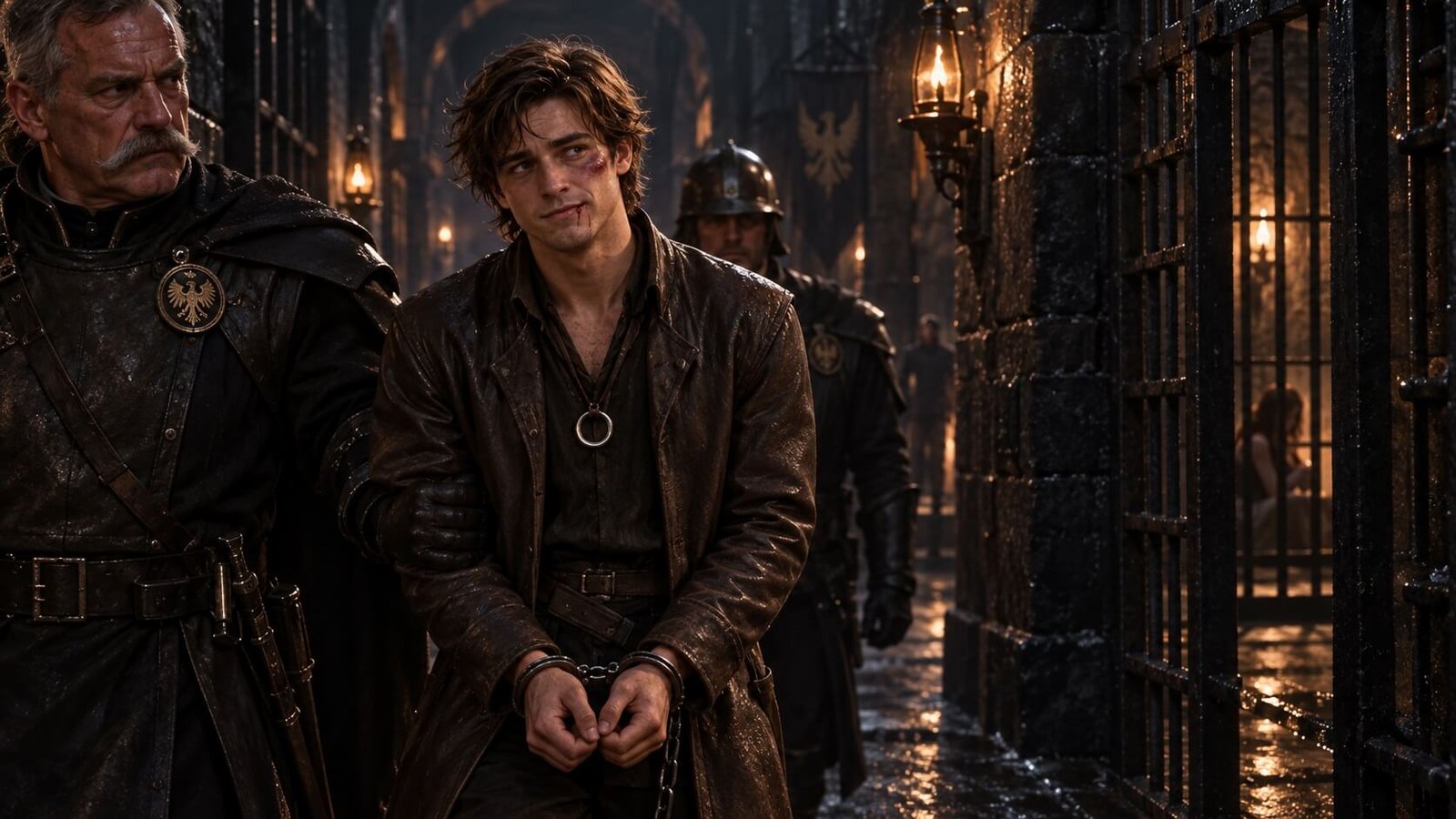
FINN
The first guard costs me four silver crowns and enough dignity that I resent the fourth coin more than the crime.
He stands beneath the arched entrance to Veyrhold Prison with rain shining across the shoulders of his uniform, looking from the money in my palm to my face as though one of us has misunderstood the nature of corruption. I have been here often enough over the past six months to recognize most of the regular night staff, but this one is new enough that he still treats procedure as something with moral weight. That would have been admirable under different circumstances. Tonight it is merely inconvenient.
“Visiting ended at the tenth bell,” he reminds me, keeping both hands conspicuously away from the coins. The clock tower beyond the prison wall struck eleven some time ago, and the rain has been falling steadily enough since then to soak the lower half of my coat despite the covered entrance. When I explain that I am aware of the hour, he frowns and adds, “Warden Pell left instructions. No visitors for Halden tonight.”
I had expected that. Pell has spent six months discovering exactly how often I am willing to interpret the word no as an invitation to improve my argument. He knows Amy well enough by now to understand that she will not sleep simply because everyone has agreed she ought to, and he knows me well enough to suspect I might decide her final night requires intervention. Both assessments are irritatingly accurate.
“I need ten minutes,” I tell the guard, opening my hand a little farther so the silver catches the lamplight. “You do not have to approve of the conversation, participate in the conversation or even know what the conversation is about. You only have to temporarily misunderstand whether you saw me.”
His eyes settle on the coins again. “Four crowns?”
There is enough offense in the question that I almost laugh. Instead I study him more carefully and ask whether he is objecting to bribery or merely to the amount. His mouth tightens, but not before I see the answer. That makes the negotiation simpler. After another moment he mutters that I have five minutes, takes the money with admirable speed and unlocks the first iron door.
The prison feels different at night. During ordinary visiting hours, clerks move between offices with ledgers pressed against their chests, soldiers exchange shifts on the stairwells and voices carry from the holding corridors in overlapping fragments. Now the same black-stone passages seem to have doubled in size. Oil lamps burn at long intervals along the walls, leaving pools of darkness between them, and somewhere below us water moves through old pipes with the slow knocking rhythm of something trying not to be heard.
I follow the guard past the first stairwell and try not to count how many times I have made this route since Amy was arrested. At the beginning I noticed everything because I expected each visit to be temporary. I noticed the cracked tile beside the records office, the warped hinge on the western gate, the clerk who eats sugared almonds when nobody is watching. Somewhere between the second month and the fourth, those details stopped being observations and became familiarity. That is the part I dislike most. A prison should never become a place where I know which corridor is warmer in winter.
The guard stops before the second security gate and warns me that another officer is stationed beyond it. His voice has lowered now that the consequences of his decision exist in physical proximity. “You are going straight to the lower corridor,” he instructs, one hand resting on the key ring at his belt. “You speak to her, you do not pass anything through the bars, and when I come back for you, you leave.”
I nod because arguing with rules before I have reached Amy would be inefficient. The guard studies me for another second and apparently finds the agreement suspicious anyway. He opens the gate, leads me down another flight of stairs and leaves me at the end of the corridor with a final warning that sounds much more like regret.
Amy’s cell is the fourth on the left.
She is awake, which surprises nobody who has met her.
A narrow lamp burns outside the bars, giving the inside of the cell just enough light for me to see her sitting sideways on the bed with a book open across one knee. Her dark hair has been braided loosely for the night and is already escaping around her face. She looks thinner than she did six months ago, although I have been careful not to mention that on any of my visits because Amy responds to concern as though it is a personal attack. There is a bruise near one wrist from something she has also refused to explain properly. Tomorrow morning the Crown intends to put a rope around her neck.
For several seconds I simply stand there.
Amy notices me before I decide what expression to wear. Her eyes move from my wet coat to the empty corridor behind me, then narrow with immediate understanding. “You bribed somebody,” she concludes, closing the book but keeping one finger between the pages.
“I find the certainty insulting.”
She shifts to face me properly. “Finn, it is almost midnight, visiting hours ended two bells ago, and Pell specifically told you not to come back tonight. Either you bribed someone or Imperial security has collapsed so thoroughly that my execution may solve itself.”
I lean one shoulder against the stone beside the bars. “Four crowns.”
Her expression changes from accusation to disbelief. “You paid four silver crowns for this?”
“The first offer was three. He had a surprisingly developed sense of professional value.”
Amy closes her eyes for a moment, and I can tell she is deciding whether laughter would encourage me. It probably would. She knows that too, which is why the smile only appears briefly before she looks down at the book in her lap.
The silence that follows is harder than getting through the gate.
For months we have avoided making tomorrow feel real by discussing everything around it. Appeals. Witnesses. The Ember Right. The possibility that a dragon might accept her where the Crown has not. Amy has spent most of that time treating death like an administrative inconvenience because the alternative would require sitting still with it, and I have cooperated because there are forms of cowardice that look very much like loyalty from the inside.
Tonight there is nothing left to organize.
“I didn’t come to convince you everything will be fine,” I tell her eventually. “I know you would hate that.”
Amy lifts her gaze again. Some of the defensiveness leaves her face, which is worse than anger would have been. “Good. Because if you start telling me the dragons will save me, I will ask the guard to remove you personally.”
“He seems financially flexible.”
That earns me the smallest breath of amusement, but it fades almost at once. Amy draws one leg beneath herself on the bed and asks why I actually came. The directness of the question leaves me with fewer places to hide than I expected.
I look past her at the cell wall. Somebody imprisoned here before her scratched a row of shallow vertical marks into the stone, then stopped at twenty-three. I have wondered about those marks on nearly every visit and never asked about them. Tonight they feel unbearably important for no reason I can explain.
“I didn’t want the last time I saw you before morning to be yesterday,” I admit.
Amy’s face stills.
I continue before she can rescue either of us with a joke. “Yesterday we argued about whether Pell’s mustache has its own disciplinary authority. That is not an unacceptable final conversation, but it seemed careless.”
She watches me for a long moment, then lowers the book completely. “Finn.”
I know that tone. It means she has already understood too much and is about to say something I would prefer she didn’t. I straighten from the wall and tell her not to make the conversation sentimental simply because we are in a prison at midnight. She ignores the warning with the confidence of someone who has ignored better ones.
“If tomorrow goes badly,” she begins, and I immediately shake my head.
Amy’s mouth hardens. “You came here because you don’t want to pretend tomorrow might not go badly. You don’t get to stop me from doing the same thing.”
There is no good answer to that. I put both hands into the pockets of my coat because otherwise I will reach for the bars, and the guard was sufficiently specific about not touching them that I suspect there is a story behind the rule.
Amy studies me before continuing. Her voice is quieter now. “If I die tomorrow, Tomas gets my knife. Not evidence storage, not the prison, not some clerk who decides it belongs in an archive because it was involved in a treason conviction. Tomas.”
“I’ll make sure he gets it.”
“My books go back to the house. All of them.”
I raise an eyebrow. “Even the terrible ones?”
“They are not terrible.”
“One of them contains a duke who spends three chapters pretending to be a stable hand despite apparently having never seen a horse.”
“That is character development.”
“That is agricultural fraud.”
Amy almost smiles, but this time I do not push the joke farther. The temptation is there. Humor is easier than watching her decide who receives her belongings after she dies. For once I let the silence remain what it is.
She notices.
That is the problem with knowing somebody for twelve years. They learn the meaning of the things you stop doing.
Amy’s expression softens as she reaches one hand toward the bars and then stops before touching them. “You don’t have to be there tomorrow.”
The suggestion is so absurd that I think I have misheard her. When I realize she means it, something sharp moves through my chest.
“I do,” I answer.
“No, you don’t.” She shifts closer, the dim prison light catching the exhaustion beneath her eyes. “You can stay in Veyrhold. You can wait until somebody comes back and tells you what happened.”
“That sounds significantly worse.”
“It might not be.”
“It will.”
Amy draws a slow breath and looks away. “I don’t want you watching if—”
She stops before finishing.
I know what she means anyway.
Mina died while I was asleep.
The thought arrives without warning and with all the old precision. For weeks before my sister’s death, I became accustomed to doors closing in front of me. Healers needed space. Adults needed to talk privately. Mina needed rest. Everyone had sensible reasons, and I obeyed enough of them that the last time I saw her alive ended with me leaving because somebody told me there would be time in the morning.
There was not.
I have never blamed the healer who sent me home. I have never blamed my parents for letting me sleep. I have never even blamed myself in any useful sense.
That has not stopped some part of me from remaining seventeen years old outside a closed bedroom door.
Amy knows most of this. She watches my face change and immediately understands where the conversation has gone.
“Mina wasn’t your fault,” she tells me.
“I know.”
“You say that like a legal answer.”
“It is the accurate answer.”
“It isn’t the same thing.”
“No.” I look down at the wet hem of my coat, then back at her. “It isn’t.”
For a while neither of us speaks. The prison settles around us, stone cooling after the lamps have burned low, footsteps moving somewhere on an upper level. I realize that this is why I came. Not because I have something useful to tell Amy, and not because ten minutes can change what happens at dawn. I came because absence has frightened me more than death ever has.
Amy seems to understand that without requiring the explanation.
“All right,” she murmurs. “Be there.”
The permission hurts more than I expected.
I nod once.
Then the outer gate opens.
The guard who took my money appears at the end of the corridor, but he is not alone.
The second officer walking beside him is older, broad through the shoulders and wearing the expression of a man who has just discovered corruption occurring without his participation. He looks at me first, then at the younger guard, and the entire problem becomes clear before either of them speaks.
The younger guard stops several yards away. “Time.”
I glance at Amy. We have probably had more than five minutes already, which means complaining would be ungenerous.
I complain anyway.
“Two more.”
The older officer answers instead. “No.”
His tone contains no room for negotiation, but experience has taught me that this is often merely a failure of imagination. I take one hand from my pocket and ask whether he would reconsider for three crowns.
The younger guard makes a small strangled sound behind him.
The older officer stares at me.
Amy covers her mouth with one hand.
“What?” I ask. “I am attempting consistency.”
The officer’s gaze shifts to his colleague, whose face has become remarkably pale. “Why is he here?”
The younger guard begins explaining something about Warden Pell’s verbal authorization.
I wince.
It is not a good lie. More importantly, it is a lie involving Pell, who possesses the sort of memory that makes improvisation around him dangerous.
The older officer asks to see the authorization.
The younger guard says it was verbal.
Amy, still inside the cell, closes her eyes.
I decide intervention is necessary before the situation becomes embarrassing. “There may have been a small financial misunderstanding.”
Both guards look at me.
Amy opens her eyes again and quietly tells me, “Stop helping.”
I would like to argue that I am helping considerably, but the older officer has already walked forward and taken hold of my upper arm. He informs me that I am leaving immediately and that the matter of bribing an Imperial officer will be addressed upstairs.
I tell him that technically only one officer has accepted a bribe.
The younger guard looks as though he might die.
The older one tightens his grip. “Move.”
I take one step, then turn back toward Amy because leaving without looking at her suddenly feels impossible.
She is standing now.
The humor has disappeared from her face. For an instant the bars between us become exactly what they are: iron placed there to prevent one person reaching another.
“I’ll see you in the morning,” I tell her.
Amy holds my gaze. “You’d better.”
The older guard pulls me toward the gate.
I make it perhaps six steps before deciding the unfinished conversation still bothers me.
“Also,” I call back, twisting far enough to see her, “if the stable-hand duke survives the third book, I am burning the series.”
Amy’s answer follows me down the corridor. “Touch those books and I will come back specifically to kill you.”
The threat is ridiculous.
It is also the first thing anyone has said tonight that makes tomorrow sound as though it contains an afterward.
I am still smiling when the older guard shoves me through the gate.
That probably explains why he dislikes me immediately.
The rest happens with disappointing speed. The younger guard attempts to disappear before anyone asks about the four crowns. The older officer asks anyway. I offer to simplify matters by considering the money a charitable donation to underpaid Imperial staff. Nobody accepts this interpretation.
By the time Warden Pell appears from the upper stairwell, he is wearing a dark coat over sleeping clothes and has failed to arrange his gray mustache into anything resembling its daytime structure.
He stops when he sees me.
I stop smiling.
Pell’s gaze travels from my wet coat to the officer holding my arm, then to the younger guard, who finally places four silver crowns on the desk between them without being asked. Understanding settles over the warden’s face with the slow exhaustion of a man who expected trouble but had hoped for a more original version.
“Finn,” he begins.
I know from the use of my given name that conditions are poor.
“I can explain.”
“I am certain you can.”
Pell comes down the final step and picks up one of the coins from the desk. He turns it once between his fingers before asking the younger guard whether this belongs to him. The man’s answer is so quiet I cannot hear it. Pell does.
Then the warden looks at me again. “You were explicitly told there would be no further visits tonight.”
“I disagreed.”
“You bribed a guard.”
“He was receptive.”
“You then attempted to bribe the officer who discovered you.”
“He was less receptive.”
Pell closes his eyes.
The older guard looks away, perhaps because some emotion has threatened his professional composure. I choose to interpret it as sympathy.
When Pell opens his eyes again, irritation has given way to something more tired. “Was it worth it?”
The question is not about the money.
I look past him toward the stairwell leading back to Amy’s level.
“Yes.”
Pell studies me long enough that I expect another reprimand. Instead his face changes almost imperceptibly. He knows what tomorrow is. He has known for six months.
Then he gives the order I should probably have anticipated from the beginning.
“Put him in restraints.”
I stare at him. “That seems excessive.”
Pell raises one eyebrow. “You bribed an Imperial prison guard, entered a restricted holding corridor after hours, refused to leave when instructed and attempted to bribe a second officer.”
“When you arrange the events like that, they sound unnecessarily criminal.”
“They are crimes, Finn.”
The older officer takes the restraints from his belt.
I look at Pell once more, hoping the years he has spent reading military histories after midnight have given him some appreciation for strategic initiative.
Apparently not.
The first cuff closes around my wrist.
I glance toward the younger guard. “I assume I receive the four crowns back.”
Pell’s mustache moves.
For one dangerous second I think he may be trying not to laugh.
Then the older officer turns me toward the holding corridor with more force than seems necessary. My shoulder catches the edge of the stone doorway, and when I object to the treatment he tells me I have not yet experienced treatment worth objecting to.
The split lip comes several minutes later.
The swollen cheek follows shortly after that.
Neither improves my opinion of Imperial hospitality.
By the time they leave me in a temporary holding room near the north gate, dawn is beginning to turn the narrow window gray. I sit on the bench with my chained hands between my knees and touch my tongue carefully to the cut inside my lip.
Somewhere below me, Amy is waking.
Somewhere above us, execution clerks are preparing documents and soldiers are preparing a carriage for Cinderdeep.
I came here because I could not bear the thought of leaving something unfinished.
The conversation is still unfinished.
That is all right.
For the first time tonight, I am glad of it.
Tomorrow requires one.